Ladle Management System
Real-Time Tracking, Thermal Monitoring, and Maintenance Management for Steel Plants
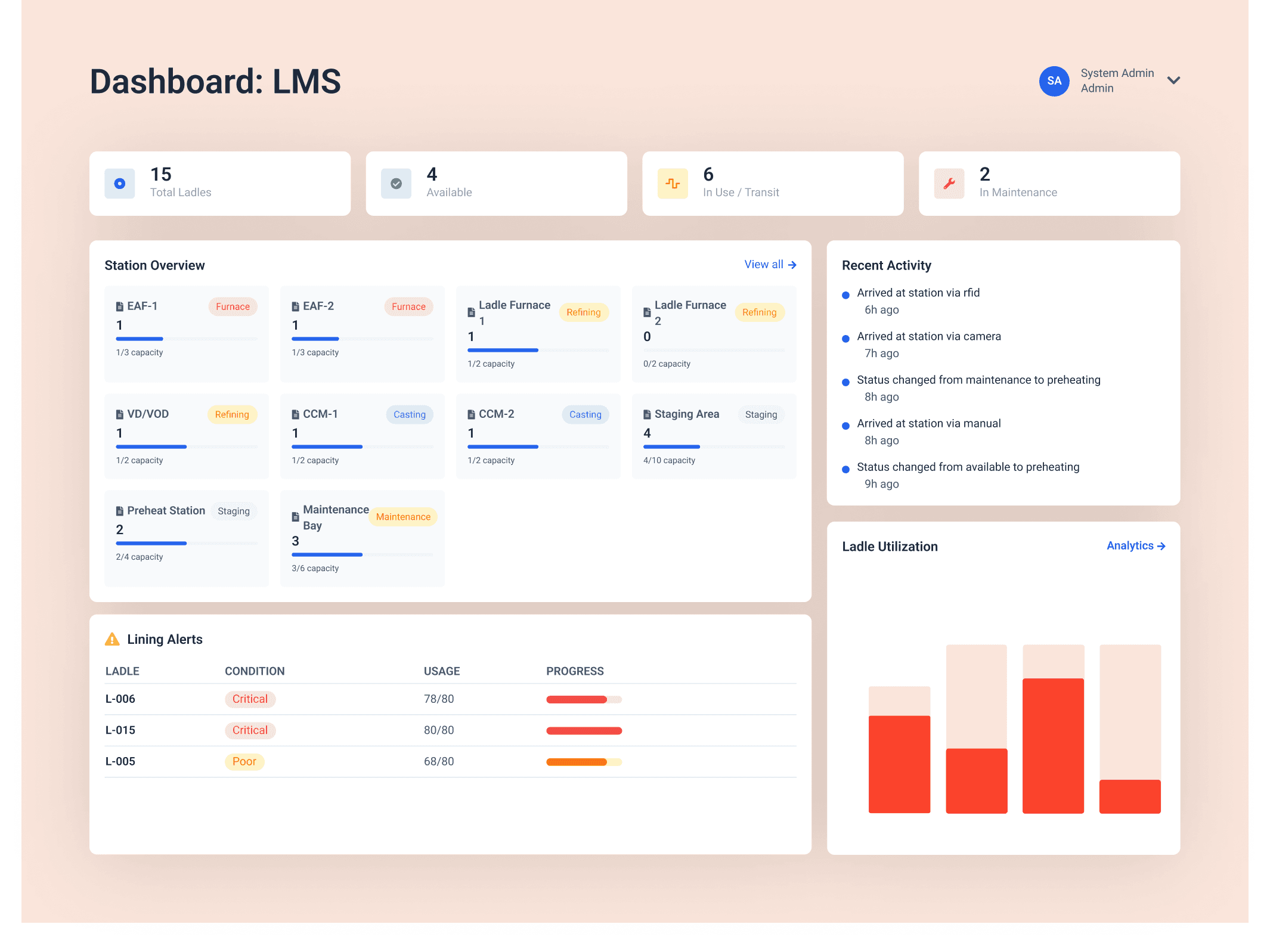

Overview
The Ladle Management System digitizes and automates ladle tracking and maintenance in steel plants. It replaces manual paper logs and spreadsheets with a fully integrated solution combining camera-based identification, thermal condition monitoring, and structured maintenance workflows.
The system provides real-time visibility, improves refractory utilization, enhances safety, and enables data-driven operational decisions.
The Challenge
Steel plants traditionally rely on manual logging and spreadsheet-based tracking of ladles. This approach leads to:
- !High dependency on manual data entry, increasing errors
- !Limited insight into refractory condition beyond heat counts
- !Inefficient maintenance planning and execution
- !Without accurate, real-time data, decisions related to ladle usage, maintenance timing, and throughput optimization remain reactive and uncertain.
The Solution
Camera-Based Ladle Tracking (OCR)
Fixed cameras capture images at key process locations. OCR technology reads painted ladle numbers and identifies each ladle in real time.
 Continuous image capture and validation logic ensure accuracy
- Real-time tracking across EAF, LRF, caster, and maintenance area
- Operational status and availability...
Circulation and Performance Analytics
The system automatically tracks ladle cycles from tapping to casting and generates:
- Current ladle location
- Zone-wise dwell time
- Ladle movement history...
- Operational status and availability...
Thermal Shell Monitoring
A dedicated thermal station scans the ladle shell to detect temperature anomalies.
- Identifies hot spots and weak areas on the shell
- Detects uneven refractory wear not visible through cycle counts
- Supports early intervention and risk reduction
- Thermal data complements circulation-based life, providing a complete picture of ladle health
Maintenance Management Module
The system includes a comprehensive maintenance module that manages the entire ladle maintenance lifecycle
- Maintenance scheduling based on life, thermal data, or planning
- Operator assignment and workload visibility
- Execution tracking for all maintenance activities
- Complete maintenance history for each ladle
- Supported activities include debricking, refractory lining, slide gate changes, and other plant-specific operations

Key Benefits
Operational Efficiency
Eliminates manual logging and duplicate data entry. Provides real-time visibility of ladle position and status
Improved Asset Utilization
Combines usage-based and condition-based maintenance. Reduces both premature and delayed maintenance
Enhanced Safety
Early detection of shell hot spots and weak points. Supports proactive maintenance decisions
Throughput Optimization
Tracks and improves turnaround time (TAT). Identifies bottlenecks through precise time tracking
Structured Maintenance Execution
Ensures all maintenance work is planned, assigned and recorded. Improves accountability and audit readiness
Without a digital management system, plants often struggle to optimize ladle usage and maintain operational continuity
Why Cameras and Painted Numbers
The system uses stencil-painted ladle numbers combined with OCR instead of RFID or QR codes.
Simple and robust in harsh environments
Easy to maintain and repaint
No dependency on additional hardware or power supply
Cameras provide both tracking and visual surveillance
Implementation
Timeline
Approximately 4 months from kickoff to stable operation.
Implementation Steps
Camera installation
Ladle number painting using stencils
Software deployment
Detection and OCR model tuning
Thermal station integration
Camera installation
Ladle number painting using stencils
Software deployment
Detection and OCR model tuning
Thermal station integration
The Ladle Management System integrates real-time tracking, thermal condition monitoring, and maintenance execution into a single platform.
It enables steel plants to move from manual, reactive processes to a structured, data-driven approach that improves safety, efficiency, and operational control.
Ready to Explore the Possibilities?
Have a question or facing an industry challenge? Connect with us to discover how Hailiot Technologies (formerly Epsum Labs) can help drive innovation and efficiency for your business.